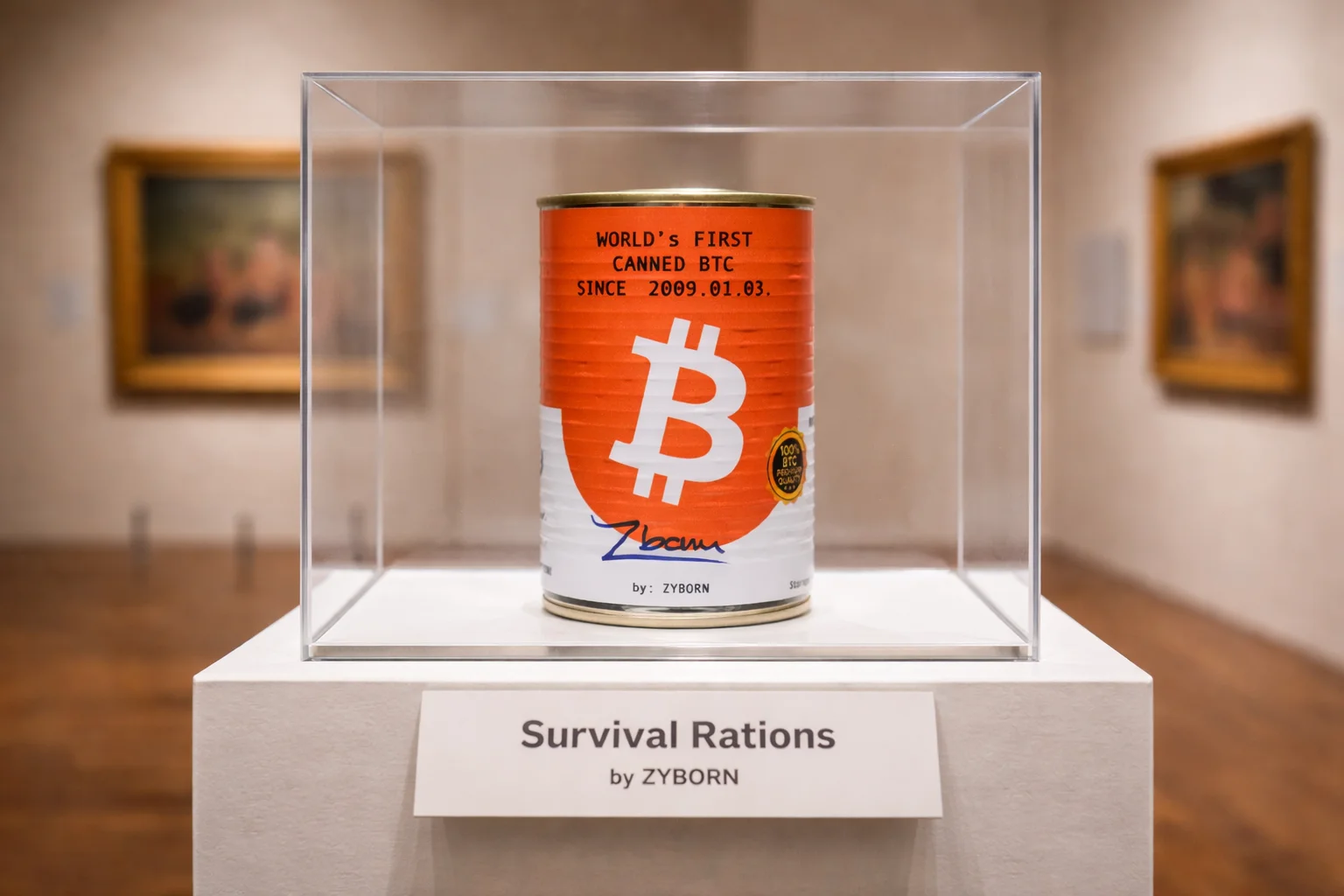
"Each can looks the same, yet contains a different amount of Bitcoin."
Zyborn's debut project FIRST CANNED BTC presents a physical embodiment of a fundamentally digital currency, transforming a mass-market household object into something both valuable and enigmatic. As global war narratives intensify, the can emerges as a symbol of durable, reliable, and psychologically reassuring food within an increasingly militarised, bloc-divided world. At once commodity and riddle, the can inspires a simple but charged question: what is inside? Bitcoin worth the equivalent of one million US dollars across a limited edition of 21 units. The amount contained within each can is variable, determined by AI rather than human decision-making, removing predictability and authorship from the act of valuation.
For me, this project marks a welcome return to the physical realm, encapsulating capitalism itself as a variable canned good. The can is conventionally associated with sameness: every unit identical, interchangeable, mass-produced. Here, that logic is quietly subverted. Each can looks the same, yet contains a different amount of Bitcoin. This gesture foregrounds a unique affordance of digital currency: weightlessness. Whether a can holds 0.01 or 1 BTC, it weighs exactly the same. With a physical currency, this would be impossible, as coins and banknotes betray value through mass. Instead, Zyborn's work masterfully stages a tension between weight and worth, visibility and value, using the immateriality of Bitcoin as its conceptual engine.
In this sense, FIRST CANNED BTC responds to a broader generational desire for tangible, real experiences amid digital saturation. At a time of screen fatigue and dematerialised trust systems, Zyborn proposes not a nostalgic return to the past, but a physical form appropriate to a digital currency, one that wasn't shaped by millennia of monetary history. The cans recall Andy Warhol's fascination with consumer packaging, mass production, and advertising. Yet while Warhol captured a new era of post-war consumer abundance in the 1960s, Zyborn addresses a contemporary urge to convert the digital back into the physical, while retaining the excitement of uncertainty and abstraction.
The metal can itself becomes a manifesto for new money: a sculptural object that could plausibly have existed in 2009. In an ironic reversal, the material of traditional money becomes the casing for a dematerialised currency. Meanwhile, the label adopts the language of canned food packaging: a simple orange palette, factual typography, consumption-ready aesthetics. Complexity is translated into the visual grammar of the everyday. The slogan further anchors the work in advertising history, positioning Bitcoin unambiguously as a product, while also acknowledging its energy consumption — a gesture that signals the project's future-facing concerns, and the artist's latent potential, where efficiency and sustainability increasingly enhance value.
Opening the can implicates the owner in a performance: an irreversible action in which the contents are finally revealed — a wallet, user manual, and an unknown amount of Bitcoin. Like a transaction itself, the act cannot be undone. Through materiality, concealment, and ritual, Zyborn's art skillfully probes how value is produced, communicated and distributed.